Monday, 15 December 2008

Kurt Cobain


Kurt Cobain

Kurt Donald Cobain

born February 20, 1967

died April 5, 1994

height 5' 7"

weight 130 lbs

lead singer, songwriter, guitarist

Seattle rock band, Nirvana

frontman, leader, reluctant spokesman

a major celebrity, around the world

but found himself in an uncomfortable position

helped push the wave of Grunge rock

1991, marked the beginning of grunge and alternative rock

with the hit song "Smells Like Teen Spirit"

noted as the "anthem-of-a-generation"

[Garofalo, Reebee - Rockin' Out: Popular Music in the USA]

other well-known songs:

"About a Girl",

"Come as You Are",

"In Bloom",

"Lithium",

"Heart-Shaped Box",

and "All Apologies"

"Famous is the last thing I wanted to be."

[Azerrad, Michael - Come as You Are: The Story of Nirvana]

Kurt Donald Cobain was the leader of Nirvana, the
multi-platinum grunge band that redefined the sound
of the nineties.

Cobain was born on the 20th of February 1967 in Hoquaim, a small town 140 kilometres south-west of Seattle. His mother was a cocktail waitress and his father was an auto mechanic. Cobain soon moved to nearby Aberdeen, a depressed and dying logging town.

Cobain was for most his childhood a sickly bronchitic child. Matters were made worse when Cobain's parent's divorced when he was seven and by his own account Cobain said he never felt loved or secure again. He became increasingly difficult, anti-social and withdrawn after his parent's divorce. Cobain also said that his parent's traumatic split fueled a lot of the anguish in Nirvana's music.

After his parent's divorce Cobain found himself shuttled back and forth between various relatives and at one stage homeless living under a bridge.

When Cobain was eleven he heard and was captivated by the Britain's Sex Pistols and after their self-destruction Cobain and friend Krist Novoselic continued to listen to the wave of British bands including Joy Division the nihilistic post-punk band that some say Nirvana are directly descended from in form of mood, melody and lyrical quality.

Cobain's artistry and iconoclastic attitude didn't win many friends in high school and sometimes earned him beatings from "jocks" Cobain got even by spray painting "QUEER" on their pick-up trucks. By 1985 Aberdeen was dead and Cobain's next stop was Olympia. Cobain formed and reformed a series of bands before Nirvana came to be in 1986. Nirvana was an uneasy alliance between Cobain, bassist Krist Novoselic and eventually drummer and multi-instrumentalist Dave Grohl.

By 1988 Nirvana were doing shows and had demo tapes going around. In 1989 Nirvana recorded their rough-edged first album Bleach Bleach - CD-Albumfor local Seattle independent label Sub-Pop.

In Britain Nirvana received a lot of recognition and in 1991 their contract was bought out by Geffen, they signed to the mega-label, the first non-mainstream band to do so. Two and a half years after Nirvana's first C.D. Bleach was released they released Nevermind, Nevermind - Japan - Vinyl-AlbumNevermind - CD-AlbumNevermind - Vinyl-Albuma series of different, crunching, screaming songs that along with it's first single Smells Like Teen Spirit Smells Like Teen Spirit - CD-Singlewould propel Nirvana to mainstream stardom.

Smells Like Teen Spirit became Nirvana's most highly acclaimed and instantly recognizable song. Not many people can decipher it's exact lyrics but Cobain used a seductive hookline to hook the listener. Nevermind went on to sell ten million copies and make a reported $550 million (US) leaving Nirvana overnight millionaires. Cobain was shocked at the reception of his highly personal and passionate music repeatedly telling reporters that none of the band ever, ever expected anything like this. It quickly became obvious that the obsessively sickly and sensitive 24yr old was not going to cope well with the rock'n roll lifestyle. "If there was a rock star 101 course, I'd really have like to take it," Cobain once observed. Cobain fell into heroin in the early 90's, he said he used it as a shield against the rigorous demands of touring and to stop the pain of stomach ulcers or an irritated bowel. Through the touring and pressure Cobain continued to write his very personal acutely focused lyrics.

Cobain was distressed to find out that what he wrote and how it was interpreted could quite often be miles apart. He was appalled when he found out that Polly a heavily ironic anti-rape song had been used as background music in a real gang-rape. He later appealed to fans on the Incesticide liner Incesticide - Japan - Vinyl-AlbumIncesticide - CD-Albumnotes "If any of you don't like gays or women or blacks, please leave us the fuck alone." It was to no avail, Cobain found that as an overnight millionaire musician control was something he had very little of. Cobain also worried that his band had sold-out, that it was attracting the wrong kind of fans (i.e the type that used to beat him up.)

In February 1992 Cobain skipped off to Hawaii to marry the already pregnant Courtney Love. Later in the year Nirvana released Incesticide and in August Cobain had hospital treatment for heroin abuse. Shortly after Frances Bean Cobain was born. In early 1993 In Utero In Utero - Vinyl-AlbumIn Utero - CD-Albumwas released into the top spot on the music charts. In Utero was widely acclaimed by the music press and it contains some of Cobain's most passionate work. In Utero was a lot more open than Nirvana's previous albums. Songs like All Apologies All Apologies - CD-Singleand Heart Shaped Box detailed aspects of Cobain's sometimes shaky marriage, other songs like Scentless Apprentice detailed the agonies and struggles of Cobain's experiences.

Nirvana embarked on a support tour and recorded and filmed an "unplugged" (acoustic) performance for MTV in November of 1993. Nirvana's choice to honour bands and people that had influenced them and Cobain's passionate and intense vocals especially on "Where Did You Sleep Last Night?"silenced many of their who had labeled Cobain talentless. Rumors circulated that the MTV Unplugged compilation would be Nirvana's last album and the band were splitting up.

Cobain was a gun fanatic and always had several in his possession or in various forms of confiscation. In the northern winter of 1993-94 Nirvana embarked on an extensive European tour. Twenty concerts into the tour Cobain developed throat problems and their schedule was interrupted while he recovered. While recovering Cobain flew to Rome to join his wife who was also preparing to tour with her own band.

On March the 4th Cobain was rushed to hospital in a coma after an unsuccessful suicide bid in which he washed down about fifty prescription painkillers with champagne. The suicide bid was officially called an accident and was not even made known to close friends and associates. Several days later he returned to Seattle. Cobain's wife, friends and managers convinced Cobain, who was still in deep distress to enter a detox program in L.A. According to a missing person's report filed by his mother Cobain fled after only a few days of the program.

Cobain was cited in the Seattle area with a shotgun. Days later on the 5th of April he barricaded himself into the granny flat behind his mansion, put a shotgun in his mouth and pulled the trigger. On Thursday April the 7th ~ two days after a medical examiner says Cobain shot himself and the day before his body was found police say Courtney Love herself was taken to hospital in L.A. for a drug overdose. Released on bail, Love checked herself into a rehab center but left soon after a friend called her the next day with news of Cobain's death.

Cobain's body was found when an electrician visiting the house to install a security system went round the back of the house when no one answered the front door and peered through windows. He thought he saw a mannequin sprawled on the floor until he noticed a splotch of blood by Cobain's ear. When police broke down the door they found Cobain dead on the floor, a shotgun still pointed at his chin and on a nearby counter a suicide note written in red ink addressed to Love and the couples then 19 month old daughter Frances Bean.

The suicide note ended with the words "I love you, I love you." Two days after Kurt Cobain's body was found about 5,000 people gathered in Seattle for a candlelight vigil. the distraught crowd filled the air with profane chants, burnt their flannel shirts and fought with police. They also listened to a tape made by Cobain's wife in which she read from his suicide note. Several distressed teenagers in the U.S. and Australia killed themselves. The mainstream media was lambasted for it's lack of respect and understanding of youth culture.

AvrilLavigne

Avril Lavigne Whibley born September 27, 1984), better known by her birth name of Avril Lavigne, is a Canadian pop rock/pop punk singer, songwriter, fashion designer, and actress. In 2006, Canadian Business Magazine ranked her the seventh most powerful Canadian in Hollywood. Avril Lavigne's music contains element of modern rock, pop punk, pop rock, powerpop and alternatif rock.

Lavigne's debut album, Let Go, was released in 2002. Nearly 17 million copies were sold worldwide and it was certified six times platinum in the United States. Her second and third albums, Under My Skin (2004) and The Best Damn Thing reached number one on the U.S. Billboard 200. Lavigne has scored six number one songs worldwide and a total of eleven top ten hits, including "Complicated", "Sk8er Boi", "I'm With You", "My Happy Ending" and" Girlfriend," which became #1 hits in the ARC Top 40. In December 2007, Lavigne was ranked at #8 in the Forbes "Top 20 Earners Under 25", with annual earnings of $12 million.Currently, Avril Lavigne has sold over 30 million albums worldwide.

Background

Lavigne was born in Belleville, Ontario on September 27, 1984, the daughter of Judy and John Lavigne. Lavigne's birth name is usually pronounced in an anglicized way as above ("La-Veen"). In French, it is commonly pronounced. Avril is French for "April", while la vigne means "the vineyard". Her French-Canadian parents are devoutly Baptist. She has an elder brother, Matthew, and a younger sister, Michelle.Lavigne's mother was the first to spot young Lavigne’s talent. At the age of 2, Lavigne began singing along with her mother on church songs. The family moved to Napanee, Ontario, when Lavigne was five years old.

In 1998, Lavigne won a competition to sing with fellow Canadian singer Shania Twain on her first major concert tour. She appeared alongside Twain at her concert in Ottawa, appearing on stage to sing "What Made You Say That". She was discovered by her first professional manager, Cliff Fabri, while singing country covers at a Chapters bookstore in Kingston, Ontario.During a performance with the Lennox Community Theatre, Lavigne was spotted by local folk singer Steve Medd, who invited her to sing on his song, "Touch the Sky," for his 1999 album, Quinte Spirit. She also sang on, "Temple of Life," and, "Two Rivers," for his follow up album, My Window to You, in 2000.

At the age of 16, she was signed by Ken Krongard, the artists-and-repertoire (A&R) representative of Arista Records, who invited the head of Arista, Antonio "L.A." Reid, to hear her sing at the New York City studio of producer Peter Zizzo.

She then completed work on her first album, Let Go. The Matrix, who worked extensively with Lavigne on the album, commented on her songwriting, saying, "We had a fabulous and unique experience with Avril, who was then a 16-year-old rapidly growing songwriter with tremendous raw talent. The songs were conceived on piano and guitar by four people: The Matrix (3) and Avril. Avril was instrumental in the songs' creation. We were all very close during the making of the record.


Music career

Let Go (2002–2003)

Main article: Let Go (Avril Lavigne album)

The album shows definite pop rock roots; however, alternative and post-grunge influences can be heard in some of the songs.

Just over one month after its release, Let Go reached multi-platinum status in late-August, and was certified triple platinum two weeks after. Before the end of 2002, just six months after its debut, it was certified four times platinum by the RIAA. As of December 2007 the album has sold 6.6 million copies in the U.S and more than 16 million worldwide.

Let Go was released on June 4, 2002 in the United States, it has reached number two there and number one in Australia, Canada, and the United Kingdom. This made Lavigne, at seventeen, the youngest female soloist to have a number-one album in the UK up until that time.

Four singles from the album were released. The first single, "Complicated" went to number one in Australia, while reaching number two on the U.S. Hot 100, and it was one of the best-selling Canadian singles of 2002. Lavigne tied a record set by Natalie Imbruglia's "Torn" when "Complicated" held the number one spot on the contemporary hit radio chart (which tracks air play on the radio) for eleven weeks in a row. "Sk8er Boi" reached the top ten in the U.S. and Australia, "I'm With You" reached the top ten in the U.S and the UK, and "Losing Grip" reached the top ten in Taiwan and the top twenty in Chile.

Lavigne was named "Best New Artist" at the 2002 MTV Video Music Awards, won four Juno Awards in 2003 (out of six nominations), received a World Music Award for "World's Best-Selling Canadian Singer", and was nominated for eight Grammy Awards, including "Song of the Year" for "Complicated" and "Best New Artist".

Under My Skin (2004–2006)


Avril in Curitiba,Brazil

Main article: Under My Skin

Lavigne's second album, Under My Skin, was released on May 25, 2004, in the U.S. It debuted at number one in the U.S., the UK, Germany, Japan, Australia, Canada, Mexico, Argentina, Spain, Ireland, Thailand, Korea and Hong Kong and sold more than 380,000 copies in the U.S. in its first week. Lavigne wrote most of the album with Canadian singer-songwriter Chantal Kreviazuk, though some tracks were co-written by Ben Moody (formerly of Evanescence), Butch Walker of Marvellous 3, her former lead guitarist Evan Taubenfeld, and her former drummer Matt Brann. Kreviazuk's husband, Our Lady Peace front man Raine Maida, co-produced the album with Butch Walker and Don Gilmore.

This album has a stronger alternative feel, along with songs showing punk-pop edges (such as He Wasn't and I Always Get what I Want), or soft post-grunge sounds (Freak Out and Who Knows).

Lead single "Don't Tell Me" went to number one in Argentina and Mexico, the top five in the UK and Canada, and the top ten in Australia and Brazil. "My Happy Ending" went to number one in Mexico and it reached the top ten in the U.S. making it her third-biggest hit there, but third single "Nobody's Home" did not make the top forty in the U.S., and it only went to number one in Mexico and Argentina. The fourth single from the album, "He Wasn't", reached top forty positions in the UK and Australia, and was not released in the U.S. "Fall to Pieces" was released as the final single from the album, but did not do as well as previous singles.


Lavigne performing in
Geneva on June 9, 2005.


Lavigne won two World Music Awards in 2004 for "World's Best Pop/Rock Artist" and "World's Best-Selling Canadian Artist". She received five Juno Award nominations in 2005, picking up three, including "Fan Choice Award", "Artist of the Year", and "Pop Album of the Year". She won the award for "Favorite Female Singer" at the eighteenth Annual Nickelodeon Kids' Choice Awards. Lavigne co-wrote "Breakaway" with Matthew Gerard, which was recorded by Kelly Clarkson for the soundtrack to the film The Princess Diaries 2: Royal Engagement (2004). "Breakaway" was later included on Clarkson's second album, Breakaway, being released as the album's first single. The song peaked inside the U.S. top ten and provided Clarkson with a substantial hit.

Lavigne went on a "Live and by Surprise" twenty-one city mall-tour in the U.S. and Canada, starting on March 4, 2004, in Minneapolis, Minnesota, to promote Under My Skin. Each performance consisted of a short live acoustic set of songs from the new album. She was accompanied by her guitarist, Evan Taubenfeld. The venue in each city was not announced until forty-eight hours before the show. The tour was very popular and was successful in promoting the album. The set at Indianapolis on March 25, 2004, at Glendale mall included "He Wasn't", "My Happy Ending", "Don't Tell Me", "Take Me Away", "Nobody's Home", "Sk8er Boi", and "Complicated". Selections of this tour were released on the Avril Lavigne Live Acoustic EP, which was released in U.S. Target stores.

The Best Damn Thing (2007–present)

Main article: The Best Damn Thing


Lavigne in Hong Kong, 2007.

Lavigne's third album, The Best Damn Thing, was released on April 17, 2007 and debuted at number one in the U.S. The album was produced by Dr. Luke, Lavigne's husband Deryck Whibley, Rob Cavallo, Butch Walker and Lavigne. Travis Barker recorded drums for the record. The first single from the album was "Girlfriend", which became Lavigne's first single to reach number one on the Billboard Hot 100. On Ryan Seacrest's radio show Lavigne said that "When You're Gone" would be the second single. Lavigne's third single from the album is "Hot". The fourth and final single of the album is "The Best Damn Thing".

"Girlfriend" has been used as the theme song for the Japanese idol hosted talk show Cartoon KAT-TUN. On May 2, 2007, she made a guest appearance during the show. She played a game of darts with the KAT-TUN group.

Lavigne has been doing a small tour to promote The Best Damn Thing, with tickets available only to members of her fan club. She began the tour in Calgary, Alberta, and played for a crowd of around two hundred. This show was aired on television on April 2, 2007, on the CBC Network. In August 2008 it was widely reported that Lavigne's August 29, 2008, concert was banned in Malaysia. On August 22, 2008, MTV reported that the Malaysia performance was approved. The album has sold a total of 5.4 million copies worldwide in October 2008. In March 2008, Avril undertook a world tour named "The Best Damn Tour" to support the album. The tour took in dates in USA, Canada, UK & Ireland, Europe and Asia.

Allegations of plagiarism and criticism of songwriting

On May 25, 2007, Lavigne, her co-songwriter Lukasz Gottwald, and her record label were sued by songwriters James Gangwer and Tommy Dunbar, who claimed that her song "Girlfriend" plagiarized their 1979 song "I Wanna Be Your Boyfriend", originally performed by The Rubinoos.

In June 2007, Canadian singer-songwriter Chantal Kreviazuk, with whom Lavigne wrote the majority of her second album, Under My Skin, spoke to Performing Songwriter magazine about Lavigne's songwriting: "I mean, Avril, songwriter? Avril doesn't really sit and write songs by herself or anything. Avril will also cross the ethical line and no one says anything. That's why I'll never work with her again. I sent her a song two years ago called 'Contagious', and I just saw the tracklisting to this album and there's a song called 'Contagious' on it--and my name's not on it. What do you do with that? See, I won't [call the lawyers], I'll just tell you. Art should not be subject to that kind of controversy.

On July 6, Lavigne denied both accusations in an open letter on her website, claiming that she had "never heard the [Rubinoos] song in [her] life" and also that she is considering taking legal action against Kreviazuk with regards to her allegations, which she considers "damaging to my reputation and a clear defamation of my character".


Lavigne in the 2007 MuchMusic Video Awards.

On July 10, Kreviazuk made a full public apology and retracted the statements made in the aforementioned interview, saying "I would like to apologize for any misconceptions concerning Avril Lavigne, which may have resulted from statements I made in my interview with Performing Songwriter magazine. It was not my intention to call Avril's songwriting ability or ethics into question. My statements and any inference from my statements, which call into question Avril's ethics or ability as a respected and acclaimed songwriter, should be disregarded and are retracted. Avril is an accomplished songwriter and it has been my privilege to work with her. Kreviazuk and Lavigne share the same manager, Nettwerk Management.

In January 2008 Dubar and Gangwer dropped their lawsuit and retracted their allegations of plagiarism after the case was settled confidentially.

The song "I Don't Have to Try" also stirred up controversy. Similarities between this song and Peaches' 2003 song "I'm the Kinda" have sparked further plagiarism speculations.

Lavigne was touring throughout most of 2005, and pursuing her acting and modelling careers. She represented Canada at the closing ceremony of the 2006 Winter Olympics in Turin, Italy, performing her song "Who Knows" during the eight minutes of the Vancouver 2010 portion. The album has sold more than 8 million copies.

Freddie Mercury


Freddie Mercury was born Farrokh Bulsara on Thursday September 5th 1946 on the small spice island of Zanzibar. His parents, Bomi and Jer Bulsara, were both Parsee (Persian). His father, Bomi, was a civil servant, working as a High Court cashier for the British Government. Freddie's sister, Kashmira, was born in 1952. In 1954, at the age of eight, Freddie was shipped to St Peter's English boarding school in Panchgani, about fifty miles outside Bombay. It was there his friends began to call him Freddie, a name the family also adopted.

As St Peter's was an English school, the sports played there were typically English. Freddie loathed cricket and long-distance running, but he liked hockey, sprint and boxing. At the age of 10 he became a school champion in table tennis. Freddie was not only a good sportsman, his artistic skills were incomparable. At the age of twelve he was awarded the school trophy as Junior All-rounder. He loved art, and was always sketching for friends or relatives.

He was also music mad and played records on the family's old record player, stacking the singles to play constantly. The music he was able to get was mostly Indian, but some Western music was available. He would sing along to either and preferred music to school work.

The principal headmaster of St Peter's had noticed Freddie's musical talent, and wrote to his parents suggesting that they might wish to pay a little extra on Freddie's school fees to enable him to study music properly. They agreed, and Freddie began to learn to play the piano. He also became a member of the school choir and took part regularly in school theatrical productions. He loved his piano lessons and applied himself to them with determination and skill, finally achieving Grade IV both in practical and theory.

In 1958, five friends at St Peter's - Freddie Bulsara, Derrick Branche, Bruce Murray, Farang Irani and Victory Rana - formed the school's rock'n roll band, the Hectics, where Freddie was the piano player. They would play at school parties, at annual fetes and school dances, but little else is known about them.

In 1962, Freddie finished school, returned to Zanzibar and spent his time with friends in and around the markets, parks and beaches. In 1964, many of the British and Indians, due to political unrest in Zanzibar, left their country, although not under forcible pressure, and among those driven out were the Bulsaras who migrated to England.

Initially they lived with relatives in Feltham, Middlesex, until they were able to find their own small, terraced house in the area. Freddie was seventeen, and had derided he wanted to go to art college, but needed at least one A level to ensure he could get in. In September 1964 he enrolled at the nearby Isleworth Polytechnic

During vacations he took a variety of jobs to earn some money; one was in the catering department at Heathrow Airport, a stone's throw from home, and the other was on the Feltham trading estate, where he had a job in a warehouse lifting and stacking heavy crates and boxes. His fellow workers commented on his 'delicate' hands, certainly not suited for such work, and asked him what he did. He told them he was a musician just 'filling in time', and such was his charm that those co-workers were soon doing the lion's share of his work.

He studied hard, although he preferred the aesthetic side of school life to the more mundane academic side, and easily achieved his Art A level, leaving Isleworth in the spring of 1966. His grade A pass and his natural skill ensured that he was readily accepted by Ealing College of Art and, in September 1966, Freddie began a graphic illustrating course at that college.

After Jimi Hendrix exploded onto the scene in 1967, and Freddie became an ardent fan, he spent time sketching and drawing his hero; drawings he would frame and use to decorate the walls of his flat in Kensington, rented by his friend Chris Smith, where Freddie had moved from the family home in Feltham. At that time Kensington was an important place to be for the art crowd - it was the base of the famous Biba boutique and the home of Kensington Market, frequented by the then 'in' crowd.

A fellow student at Ealing College was bass player Tim Staffell, with whom Freddie became good friends. As Tim's and Freddie's friendship became closer, Tim took him along to rehearsals of his band called Smile, with Brian May on the guitar and Roger Taylor on the drums. Freddie got on famously with Brian and Roger and loved the sound that Smile had achieved; he also had immense admiration and respect for Brian's guitar-playing. Inspired by Smile, Freddie began to experiment with music for the first time since leaving India.

He initially began to practice with Tim, another art student Nigel Foster, and with Chris Smith. "The first time I heard Freddie sing I was amazed," recounts Chris. "He had a huge voice. Although his piano style was very affected, very Mozart, he had a great touch. From a piano player's point of view, his approach was unique."

"Freddie and I eventually got to write little bits of songs which we linked together," adds Chris. "It makes sense when you consider Bohemian Rhapsody. It was an interesting way getting from one piece in a different key signature to another. But I don't think we actually finished anything. Freddie certainly taught me a lot at those sessions. He had great, natural sense of melody. I picked that up straight away. For me it was the most interesting aspect of what he was doing."

Freddie left Ealing College in June 1969, with a diploma in graphic art and design, and a few commissions for adverts in local newspapers. He moved into Roger Taylor's flat, and that summer opened a stall with Roger at Kensington Market, initially selling artwork by himself and fellow Ealing students, and later Victorian or whatever clothes, new and secondhand, he could lay his hands on.

In the summer of 1969 Freddie was introduced to a Liverpool band called Ibex, who had come to London to try to make a name for themselves. Ibex were a three-piece, with guitarist Mike Bersin, John 'Tupp' Taylor on bass and Mick 'Miffer' Smith on drums. They also brought with them their apprentice manager, roadie and general dogsbody Ken Testi; part-time bass player Geoff Higgins used to travel down for occasional gigs. Geoff would play bass when Tupp, a great Jethro Tull fan, wanted to play flute.

Freddie first met Ibex on 13th August 1969. Such was his enthusiasm, that just ten days later, he'd learned the band's set, brought in a few new songs, and had traveled to Bolton, Lancashire, for a gig with them - his debut public performance. The first date was 23rd August, and the occasion was one of Bolton's regular afternoon 'Bluesology' sessions, held at the town's Octagon Theatre. On the 25th August, Ibex appeared in the first 'Bluesology pop-in', an open-air event on the bandstand in Bolton's Queen Park, and the proceedings were covered in Bolton's 'Evening News'. This even featured an uncredited photograph of Freddie.

While Freddie's trip to Bolton with Ibex was photographed, Ibex's appearance at the Sink was recorded. This recording was made by Geoff Higgins; as he says, tape is chronic quality, but it demonstrates Ibex's love of Cream, Jimi Hendrix, as well as Freddie's favourite of the day, Led Zeppelin.

Somewhere between 9th September and the end of October 1969 Ibex underwent a mini upheaval - at Freddie's instigation. "I recall him canvassing the idea of calling the band Wreckage, but nobody was very enthusiastic," reveals Mike Bersin. "Then he phoned me one night and said, 'The others don't mind. How do you feel?' I said, 'If they agree, then fine'. When I spoke to the others about it, Freddie had phoned them all up and had the same conversation."

The name-change went hand-in-hand with the departure of drummer Mike 'Miffer' Smith. He was replaced by Richard Thompson, the former drummer in Brian May's 1984. Despite flashes of true potential, the end of the 1960s also marked the end of Wreckage. Gigs were few and far between, and while John Taylor, Richard Thompson and Freddie remained in London, Mike Bersin was committed to his college course in Liverpool, as he promised to his parents. Inevitably, the band petered out.

Freddie started to search for another band for himself. He found Sour Milk Sea after seeing a "Vocalist Wanted" advert in the 'Melody Maker'. The pomp and ceremony were impressive, and the band he was auditioning for knew he was the right man, especially when he got around to singing. Freddie had a great voice, with terrific range. But there was not only his voice that made his performances so attractive to people. "He knew how to front a show," - Ken Testi recalls. "It was his way of expressing that side of his personality. Everything he did on stage later in Queen, he was doing with Ibex at his first gig." It wasn't anything that could be developed. It was his charisma, his pure natural gift that was in perfect harmony with his voice, his appearance, his delicate taste and his musicianship in the wide sense of the word. The fact that he realized it himself made him absolutely fascinating!

They offered him the job, and in late 1969 Freddie became the lead singer with Sour Milk Sea. The other members of the band were Chris Chesney on vocals and guitar, bass player Paul Milan, Jeremy 'Rubber' Gallop on rhythm guitar and Rob Tyrell on drums. They did a few rehearsals, and then a few gigs in Oxford (Chris's home town).

Freddie and Chris, who was about seventeen at the time, became close friends and Chris moved into the house that Freddie shared with Smile in Ferry Road, Barnes. The other members of Sour Milk Sea were more than a little peeved Chris and Freddie spent so much time together, and felt rather insecure about the future of the band. After just two months Jeremy, who owned nearly all the equipment, derided to take it back and break up the band.

In April 1970 Tim Staffell decided to leave Smile, and Freddie join them as lead singer. Freddie decided to change the name of the band to Queen, he also changed his last name to Mercury.

The further biography of Freddie Mercury is to considerable degree a story of Queen.

In 1970 Freddie met Mary Austin. They lived together for seven years and remained good friends until his death.

In 1971 John Deacon joined the band and Queen were complete. Freddie designed the band's logo using their birth signs: two fairies for him (Virgo), two lions for Roger and John (Leo) and a crab for Brian (Cancer). Freddie was the author of the first Queen song that entered the British charts (Seven Seas Of Rhye), the first big hit (Killer Queen) and the most famous Queen song that was on the top of charts for 9 weeks (Bohemian Rhapsody). Freddie has always been considered the front-man of the band.

In 1975 Queen toured Japan. A crowd of screaming fans followed them everywhere. They were taken by surprise at the strength of their reception. Freddie fell in love with Japan and soon became a fanatical collector of Japanese art and antiquities.

On October 7th, 1979 Freddie performed with the Royal Ballet. He had never done any ballet before, but it was something he had always wanted to try. The songs he had chosen to perform to were Bohemian Rhapsody and Crazy Little Thing Called Love. Songs were played by the orchestra with Freddie doing live vocals. Freddie's first dance was Bohemian Rhapsody, and he performed with skill in front of a packed house of enthusiastic balletomanes, who loved him, and he received a standing ovation for both his cameo performances.

In 1980 Freddie changed his image. He cut his hair and grew a moustache. His fans began to send him gifts of nail polish and razor blades.

At the end of 1982 Queen all agreed they wanted to take break from each other. They announced they wouldn't be touring throughout 1983. Freddie had been thinking of making a solo album for some time, and at last he had time to do something about it. He booked studio time at Musicland in Munich and began work in early 1983. During that time he was introduced to Georgio Moroder, who was working on a re-release of the 1926 Fritz Lang silent science fiction film Metropolis. He wanted to put a contemporary musical score to the film. He asked Freddie to consider collaborating on a track for the film to which Freddie agreed. He had never before co-written with anyone outside Queen, and had not recorded anyone else's compositions, apart from Larry Lurex. The result of this co-operation was the song Love Kills.

In 1983 Freddie attended a performance of Verdi's Un Ballo In Maschera at the Royal Opera House sometime in May. It was the first time when he saw Spanish opera diva Montserrat Caballé, and the sheer power and beauty of her voice mesmerized him.

On September 10, 1984 Freddie's first solo single was released. It was the track he had co-written with Georgio Moroder for Metropolis, Love Kills.

The first single from his forthcoming solo album was I Was Born To Love You. It was released on April 9, 1985. Three weeks later Freddie's first solo album Mr. Bad Guy was released on CBS Records.

July 13, 1985 was a special day for Queen and Freddie. It was the day of their memorable performance at Live Aid, a tremendous show at Wembley Stadium in front of 72,000 people. Live Aid was also broadcast to over one billion people worldwide. Queen secured their place in history, as every media person, journalist, fan and critic unanimously agreed: Queen stole the show.

The early part of 1987 was very quiet for Queen, so Freddie took the opportunity to go into Townhouse Studios to do some solo work. It resulted in a remake of the classic Platters' song The Great Pretender. The single was released on February 23rd.

In March 1987 Freddie flew to Barcelona to meet Montserrat Caballé. He gave her a cassette with two or four songs. The Spanish opera diva liked these songs and even performed one of them at London's Covent Garden. Freddie was delighted. In early April, Freddie began work on the album he agreed to record with Montserrat Caballé.

At the end of May the island of Ibiza staged a huge festival at the outrageous Ku Club. Freddie agreed to be a guest of honour and closed the event with Montserrat Caballé singing the song he had written for her and her home city, Barcelona.

On October 8th, 1988 Freddie and Montserrat appeared at the huge open air La Nit festival in Barcelona. They performed three tracks from their forthcoming album - How Can I Go On, The Golden Boy and Barcelona, accompanied by Mike Moran on piano. The long-awaited album, Barcelona, finally come out on October 10th.

October 8th was the last time Freddie Mercury performed on stage. At the time, he was terribly ill with AIDS, although he didn't want people to know about it. He announced that fact the day before he died. Being ill he continued to compose and record songs and even took part in making videos. In my opinion, I'm Going Slightly Mad video is his masterpiece.

On November 24th, 1991 Freddie died peacefully at his home in London of AIDS-related bronchial pneumonia.

On April 20th, 1992 a tribute concert in Freddie's memory was held at Wembley Stadium, and many famous rock stars took part in it. But the best tribute to Freddie was the album Made In Heaven, released on November 6th, 1995 by the three remaining members of Queen. We can hear the last songs that Freddie composed and recorded.

Thank you Freddie. We love you.

Paul Gilbert


Paul Brandon Gilbert (born November 6, 1966 in Illinois, United States of America) is an American guitarist best known for his work with Racer X, Mr. Big, and his more recent instrumental albums. He also joined Joe Satriani and John Petrucci on the 2007 G3 tour.

Shrapnel Records

Around 1981-82 Paul first contacted Mike Varney, founder of Shrapnel Records, asking for a gig with Ozzy Osbourne. At the time Varney couldn't think why Osbourne would want a 15 year old guitarist, but after listening to his demo it changed his mind. They talked for the next 3 years, until Paul came to L.A for the GIT ( Guitar Institute of Technology ), and then was ready to record Racer X's debut album Street Lethal.

Racer X

Formed in Los Angeles in 1985, Racer X originally comprised Paul Gilbert (guitar), Juan Alderete (bass), Harry Gschoesser (drums) and Jeff Martin (vocals). They were heavily influenced by Judas Priest and Gilbert's playing was reminiscent of Yngwie Malmsteen, displaying fast-driven solos with extreme-level technique. Gschoesser was replaced by Scott Travis (later known for being the drummer for Judas Priest) in 1986, and Bruce Bouillet was added as a second guitar player. Bouillet was a very skilled player, as he had to play over Gilbert's always difficult and challenging phrases. Paul Gilbert gained recognition as one of the fastest guitar players in the world due to incredibly technical pieces like "Frenzy", "Scarified", "Y.R.O." and "Scit Scat Wah". Gilbert left Racer X in 1988, and the members of the band went their separate ways. The band would eventually reform, after Paul received an e-mail from a disgruntled fan under the alias "Snakebyte" about the musical direction of his solo albums. Snakebyte accused Paul of abandoning the shred guitar genre that he helped popularize with Racer X.

Paul contacted the members of Racer X, and all agreed to return, with the exception of Bruce Bouillet. In mid-1999 the band recorded the album Technical Difficulties. Technical Difficulties went gold in Japan, and Racer X's new record label requested a follow-up. In late 2000, the band released what is recognized by many fans as their best album to date, Superheroes. The record was mixed by former Racer X guitarist, Bruce Bouillet.

In order to further capitalize on their new-found success in Japan, Universal Japan requested that the band record a live show for another live CD and DVD. On May 25, 2001, the band played their first live performance in thirteen years to a sold-out crowd at the famed Whisky a Go Go in Los Angeles. The show was recorded for both audio and video, and in 2002, both the CD and DVD were released under the name Snowball of Doom.

In January 2002, in support of Superheroes and Snowball of Doom, Racer X toured Japan and Taiwan. The band performed these shows in their Superheroes costumes, and the final show, in Yokohama, was hastily recorded in two tracks on the sound board and was to be later released as Snowball of Doom 2. Later that year, Universal Japan pushed for another Racer X release. In October of 2002, all four members of Racer X gathered at Gilbert's house in Las Vegas to record Getting Heavier, which was sold alongside Snowball of Doom 2 in a package deal. Although the album was a successful release in Japan, some fans were disappointed with the lighter tracks, which resembled a Paul Gilbert solo album more so than a traditional Racer X album.

Racer X will perform at the 2009 NAMM show at the Anaheim Convention Center in Anaheim, California. Andy Timmons and his band will open the show, followed by a solo set from Paul Gilbert, and finally Racer X. The Racer X lineup will consist of Paul Gilbert, Scott Travis, Jeff Martin and John Alderete.

Mr. Big

When Billy Sheehan left David Lee Roth's band in 1988, he joined with Paul Gilbert, who had left his former band, Racer X. They founded Mr. Big, with Pat Torpey on drums and singer Eric Martin. The band was a huge success in Japan, and became famous in 1991, with Lean Into It, their second album, which featured the ballad "To Be With You", which received strong media play and reached #1 on the Billboard Hot 100. Gilbert continued playing in Mr. Big until the late 90s. He left the band in 1997 to pursue a solo career, and was replaced by Richie Kotzen. Mr. Big disbanded in 2002.

Projects

In May 2003 he played on an only twice-performing project called Yellow Matter Custard, a Beatles cover band consisting of Mike Portnoy (Dream Theater), Neal Morse (ex-Spock's Beard), and Matt Bissonette. A CD and DVD are available. They took their name from a lyric in "I Am the Walrus": "Yellow matter custard, dripping from a dead dog's eye".

He rejoined Portnoy along with Dave LaRue and Daniel Gildenlöw for a Led Zeppelin tribute band called "Hammer of the Gods" in 2004, again with Portnoy in September 2005, with Sean Malone, and Jason McMaster in the Rush tribute band "Cygnus and the Sea Monsters", and yet again with Portnoy, Gary Cherone, and Billy Sheehan in May 2006, as Amazing Journey: A Tribute to The Who, playing three shows. The band (excluding Sheehan) destroyed their equipment after the show in homage.

He was also revealed to be the guest guitarist on the Neal Morse solo album, Sola Scriptura.

In 2007, Paul Gilbert toured with Bruce Bouillet for promotion of his first instrumental album, Get Out of My Yard, which was released in 2006. Also joining him was his wife, Emi Gilbert, on keyboards. Paul Gilbert also joined Joe Satriani and John Petrucci in the 2007 G3 tour. This was the 5th North American G3 run and the 12th tour worldwide since its inception.

Paul's new instrumental CD titled Silence Followed By A Deafening Roar was released in Japan on January 23, 2008, in Europe on March 31, 2008, and in America on April 8, 2008. This is Paul's second instrumental album.

Influences and Style


Talking about his influences, Paul mentions many different artists, including Tony Iommi, Alex Lifeson, Jimmy Page, Robin Trower, Judas Priest, Akira Takasaki, Jimi Hendrix, Kiss, Van Halen, Randy Rhoads and The Ramones. He is also a great fan of The Beach Boys and The Beatles. He states on the Space Ship Live DVD that George Harrison is one of his favorite guitar players. Guitar World magazine declared him one of 50 of the world's fastest guitarists of all time, along with Buckethead, Eddie Van Halen, and Yngwie Malmsteen.

Gilbert composes music in a wide variety of styles including pop, rock, metal, blues, funk and classical, but is perhaps best known for his versatility and speed, which helped him be named as one of the "Top 10 Shredders Of All Time" by Guitar One Magazine.

Instructor

Paul Gilbert wrote his own section of the British guitar magazine, Total Guitar, where he normally demonstrated guitar techniques in the magazine and accompanying CD. Even before that, he contributed instructional articles to Guitar Player Magazine in a late 80s/early 90s series entitled "Terrifying Guitar 101". His period of working with Total Guitar spanned thirty-one issues until the November 2006 issue. Paul also teaches at the Guitar Institute of Technology (GIT) regularly, and is also an "honorary dean" of the GIT division in Japan. Paul visits Japan, enjoying the lifestyle and like his Shrapnel labelmate Marty Friedman, who to this day still lives in Japan and speaks Japanese fluently. Gilbert now writes a column for Guitar World entitled "Shred Alert".

Gear

Paul Gilbert primarily uses his Ibanez PGM signature series guitars, identified by their unique painted "f-holes". Although earlier PGM models featured the Ibanez Lo-Pro/Edge double locking tremolo system, many of his guitars (such as his main PGM300) have since been modified to accommodate a fixed bridge, hence the Ibanez PGM301 series. Along with his signature guitars, Gilbert often uses his sticker-covered "Dino" Ibanez RG750, in addition to a wide variety of Ibanez solidbody and semi-hollow electric guitars. Recently, Gilbert started using specially-designed Ibanez Iceman guitars with reverse bodies.

Regarding amps, Gilbert used ADA preamps and rack effects units early in his career prior to switching to Laney amplifiers. He praised the Laney amps as having "the best natural distortion of any tube amp ever heard". Since the G3 2007 tour however, Gilbert stated that playing with Joe Satriani and John Petrucci inspired him to take a closer look at his own guitar sound. As a result of his search he found the Marshall Vintage Modern series. He currently uses the Marshall Vintage Modern 2266c combo amps. Paul uses Jim Dunlop Tortex picks he prefers the orange (.60mm) picks.

Gilbert uses few effects, especially in comparison to some of his peers. He uses a Dunlop Wah, a delay, t.c.electronic flanger/chorus, Electro-Harmonix electric mistress flanger and an MXR phase 90, running the delay pedal in the effects loop of his Laney amps. On stage he has also been seen using a Fulltone OCD Overdrive, most recently at The Benefit for Cliff concert that took place at the House of Blues Los Angeles September 30, 2006.

Paul also used a modified vintage ADA Flanger from the 70s. You can hear it on tracks like 'Bucket of Rocks' and he also uses it on the 'Snowball of Doom' DVD. Paul claims the Flanger has been modified and he uses it to change the pitch from high to low to create a sound similar to a dive bomb. He also uses the Psilocybe phaser and THC chorus pedals from Home Brew Electronics.

In the intro to "Get Out Of My Yard" Paul uses a Boss DD-3 Delay pedal to achieve the altered pitch looped effect at the beginning of the track. This was also demonstrated by Paul on the instructional DVD of the same name.

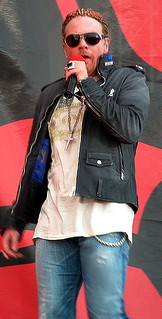
Axl Rose


W. Axl Rose(born William Bruce Rose, Jr.February 6, 1962), frequently called Axl Rose, is an American musician, best known as the lead vocalist of hard rock band Guns N' Roses.

Rose grew up in Indiana in a troubled family environment. His love of music was fostered by singing in church, participating in school chorus and studying piano, but his numerous run-ins with the police and activities as a teenager led to his leaving home at a young age. After moving to Los Angeles in 1982, Rose fronted various local bands, eventually forming Guns N' Roses with former L.A. Guns bandmate Tracii Guns.

As lead singer for Guns N' Roses, Rose enjoyed tremendous success, recognition, record and concert ticket sales in the late 1980s and early 1990s before dropping out of the public eye for several years. In 2001, he resurfaced with a new line-up of Guns N' Roses, and has since played periodic concert tours, finally releasing the long delayed Chinese Democracy in 2008.

The only original member still part of the band's line-up, Rose still places high in numerous polls as one of hard rock's all-time greatest frontmen, but is also infamous for his onstage antics and high-profile disputes with former bandmates and others in the entertainment business.

Early years

Rose was born as William Bruce Rose, Jr. in Lafayette, Indiana, to parents Sharon E. and William Rose. His father left the family when Rose was two years old. As an adult, after recovering repressed memories in therapy, Rose publicly stated that he was sexually abused by his biological father.

Rose's mother remarried when he was a small child. She changed his name to William Bailey, using the last name of her new husband, L. Stephen Bailey. He has two younger half-siblings, a sister named Amy and a brother named Stuart. Rose has stated that he, as well as his siblings, were physically abused by Bailey. Growing up, Rose believed that Bailey was his biological father.

Because of his turbulent upbringing and his mother's reluctance to leave the abusive Bailey, Rose is said to have issues with women. He claimed in an interview with Rolling Stone magazine in April 1992, that during his childhood, he was made to believe that women and sexuality were evil and that due to the violent treatment of his mother by his stepfather he witnessed as an impressionable child, he had been led to think that domestic violence was the normal way of doing things.

The Bailey household was deeply religious, and Rose grew up attending a Pentecostal church, where he was required to attend services three to eight times per week. He sang in church from the age of five, and also performed at services with his brother and sister in the "Bailey Trio". Rose was so involved with the church that he even taught Sunday School. Later, he spoke of his disillusion with his religious upbringing:

My particular church was filled with self-righteous hypocrites who were child abusers and child molesters. These were people who'd been damaged in their own childhoods and in their lives. These were people who were finding God but still living with their damage and inflicting it upon their children. I had to go to church anywhere from three to eight times a week. l even taught Bible school while l was being beaten and my sister was being molested.

—Axl Rose

Church did provide an outlet for Rose's musical interests. In addition to singing in church, he also participated in his high school chorus and studied piano.

Rose's original range is a baritone, but due to his vocal skills, he can sing parts ranging from bass, to baritone, and to a high falsetto/soprano, and has several different recognized "voices" used in his songs. He has stated that he originally started to develop his range to confuse his chorus teacher in school.

He attended Jefferson High School in Lafayette. At age 17, while going through papers in his parents' home, Rose learned of his biological father's existence and his own origins, and readopted his birth name, William Rose. He referred to himself as W. Rose only, however, as he did not wish to share a name with his biological father.

After discovering the truth of his background, Rose began "acting out" in earnest. He was in trouble numerous times with the police and was arrested over twenty times on charges such as public drunkenness and assault. At age 16, he was kicked out of his house for not cutting his hair. At this age, Rose also met Izzy Stradlin in a driver's education class.The two bonded over their love of rock music and eventually started playing in bands together. Stradlin eventually left Rose, and Indiana, to go to Los Angeles and focus on music.

Lafayette authorities threatened to charge Rose as a habitual criminal in his late teenage years. When he was 17, on the advice of his lawyer, he left Indiana and began hitchhiking and taking buses across the country.Although he returned to Indiana to visit family from time to time, he left for good in December 1982 and moved to Los Angeles, accompanied by a girlfriend.

Rose eventually adopted the name W. Axl Rose ("Axl" after a band in which he once played), and set out to re-unite with Stradlin. Rose legally changed his name to "W. Axl Rose" in 1986,and had the moniker tattooed on his arm.

Pre-Guns N' Roses years (1983-1984)

Once in Los Angeles, Rose began performing with various local bands, including Rapidfire, Rose, L.A. Guns and Hollywood Rose.While struggling to make an impact on the Hollywood music scene, Rose held down a variety of survival jobs, including the position of night manager at the Tower Records location on Sunset Boulevard. In an attempt to earn money, he and Stradlin even smoked cigarettes for a scientific study at UCLA for the reported wages of $8/hour.

Success with Guns N' Roses (1985-1994)

Main article: Guns N' Roses

Rose and his L.A. Guns bandmate Tracii Guns formed Guns N' Roses in March 1985. The band was a merger of L.A. Guns and Hollywood Rose, and featured musicians who had played for one or both groups, including Ole Beich and Duff McKagan. The band debuted at the Troubadour in Hollywood and proceeded to play the L.A. circuit, eventually building a fan following and attracting the attention of several record companies.The lineup eventually solidified with Rose on vocals, Slash on lead guitar, Izzy Stradlin on rhythm guitar, Duff McKagan on bass and Steven Adler on drums. Guns N' Roses was signed to Geffen Records in 1986 and released a four-song EP, Live ?!*@ Like a Suicide, on their own label, UZI Suicide, in December of that year.

The band's major label debut album, entitled Appetite for Destruction, was released in the United States on July 21, 1987. The record had a slow start, selling only 500,000 copies in the first year of its release. However, fueled by relentless touring and the mainstream success of the single "Sweet Child o' Mine", Appetite for Destruction rose to the #1 position on the Billboard 200 chart in the United States in the fall of 1988. To date, Appetite for Destruction ranks as the fourth best-selling debut album in the United States, has been certified 15x platinum by the RIAA, and has sold over 27 million copies.

With the success of Appetite for Destruction and its follow-up EP, GN'R Lies, Rose found himself lauded as one of rock's most prominent frontmen. In a 1990 interview with MTV, journalist Kurt Loder referred to Rose as "maybe the finest hard rock singer currently on the scene, and certainly the most charismatic."He was featured on the cover of Rolling Stone magazine in August 1989 and again in April 1992.
In 1990, Guns N' Roses returned to the studio to begin recording the full-length follow-up to Appetite for Destruction. Recording sessions were temporarily scuttled when Steven Adler, battling drug and alcohol addiction, was fired in July 1990 and replaced by former Cult drummer Matt Sorum.The band fired their manager, Alan Niven, in May 1991, replacing him with Doug Goldstein. According to a 1991 cover story by Rolling Stone magazine, Rose forced the dismissal of Niven, against the wishes of some of his bandmates, by refusing to complete the albums until he was replaced.

With enough music for two albums, the band released Use Your Illusion I and Use Your Illusion II on September 17, 1991. The tactic paid off when the albums debuted at #2 and #1 respectively on the Billboard chart, setting a record as Guns N' Roses became the only group to date to achieve this feat. The albums spent 108 weeks on the chart.

In the late spring of 1991, before the Illusion albums were released, Guns N' Roses embarked on the 28-month-long Use Your Illusion World Tour. It became famous for both its financial success and the many controversial incidents that occurred at the shows.

During the tour, Rose demanded, and received, sole ownership of the Guns N' Roses name from bandmates Slash and McKagan.His relationships with his bandmates became increasingly strained: Izzy Stradlin left the group voluntarily on November 7, 1991, and was replaced by former Kill For Thrills guitarist Gilby Clarke for the remainder of the two-year tour. Clarke himself left in 1994, and was replaced by Rose's childhood friend Paul Tobias. When Rose replaced Slash's guitar parts with those of Tobias on the band's cover version of the Rolling Stones' song "Sympathy for the Devil" for the soundtrack of the film Interview with the Vampire, tension increased further. Slash, McKagan and Sorum all left Guns N' Roses at various points between 1996 and 1997, leaving Rose and keyboardist Dizzy Reed as the only remaining Illusion-era members of the band.

While the Guns N' Roses name is owned solely by Rose, the band's back catalog is controlled jointly by Rose, Slash and McKagan. In 2004, the three presented a united front in a joint lawsuit against Universal and Geffen, in which they unsuccessfully attempted to block the release of the Greatest Hits compilation album.

Slash and McKagan have also filed several lawsuits against Rose for matters related to control and administration of the songs in the Guns N' Roses catalog. One of the cases, in which McKagan and Slash stated that they had been denied royalty checks for Guns N' Roses's sales in 2005, was determined to be the result of a clerical error by ASCAP and was resolved.

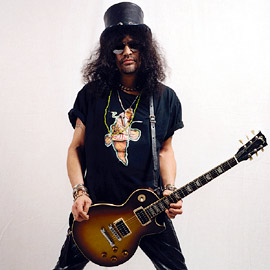
SLASH


SLASH was born in Hampstead (London), England on July 23, 1965, and he was raised in Stoke-On-Trent, Staffordshire,England. His given name is Saul Hudson. His mother is a Black American, and his father is a white Englishman. Both parents are artistic and work in the entertainment field. His mother is a clothing designer for entertainers. She designed some of David Bowie's unforgettable costumes. His father provides art direction for record albums. Two notable clients are Neil Young and Joni Mitchell.

At age 11 SLASH moved to Los Angeles with his mother while his father remained based in England. Born in the UK, SLASH was an immigrant in the United States and was to remain one for many years. The family eventually lived together again in L.A. where SLASH had a rough transition to conservative Southern California. The long hair, jeans and t-shirts that he wore even then didn't exactly fit with the other kids. An outsider at school, he lived a bohemian life at home. Surrounded by artistic friends of his parents, SLASH grew accustomed to the moods and eccentricities of those in the music world. Frequent visitors at the Hudson household included Joni Mitchell, David Geffen, David Bowie, Ron Wood and Iggy Pop. SLASH has said that these surroundings prepared him for coping with the stress of the music industry, the conflict between artistry and business.

In the mid-1970's, his parents separated. SLASH moved in with his beloved grandmother until he could sort out the situation at home. About this time SLASH discovered BMX (bicycle motorcrossing), joined up with a group of kids, and rode with a passion. It's not surprising to hear that SLASH would ride without brakes! SLASH eventually became a professional BMX biker winning awards and money for his great riding.

While in junior high school (age 15), SLASH's grandmother gave him his first guitar. Although it had just one string, SLASH was able to learn to play. SLASH's early musical influences were Led Zep, Eric Clapton, the Rolling Stones, Aerosmith,Jimi Hendrix, Jeff Beck, Neil Young. He credits the Aerosmith album ROCKS with changing his life. Getting to play with the musical idols of his life means a lot to him. Standing on a stage in Paris with Jeff Beck and Joe Perry was overwhelming. SLASH also has gotten to play with guitarist "god" Eric Clapton. He has played with many other artists including Lenny Kravitz, Paul Rogers, Iggy Pop, Michael Jackson, Brian May to name just a few.

Soon the bike was put aside. SLASH devoted at least 12 hours a day to playing guitar. His schoolwork suffered when he skipped classes and sat in the bleachers all day playing guitar. School may have suffered, but his social life got better! The other kids now thought SLASH was cool, and he was no longer a social outcast. SLASH joined band after band jamming with other young musicians. Eventually, SLASH gave up on school and dropped out in eleventh grade. Another education was waiting for him in the L.A. band scene. SLASH met Steven Adler, formed the band Road Crew, and was looking for a good singer. Then he met Izzy Stradlin who played him a tape of W. Axl Rose singing. SLASH went to see Axl perform and immediately wanted to steal him from Izzy, but the two Indiana natives were fast friends. SLASH found his bass player in Duff McKagan when Duff answered an ad SLASH had placed in the paper. All the players changed combinations, but the result was Guns N'Roses! With a lot of talent and a lot of drive, the band became an international success story.

After the Illusions tours, Guns N'Roses went on a well-deserved hiatus, and SLASH became a U.S citizen. He decided that immigration hassles, lost green cards, etc. were just too timeconsuming for his lifestyle. So SLASH became a citizen of the United States. Welcome, SLASH! About this time, SLASH became restless and decided to form a new band as a side project to his GNR work which seemed to be taking forever to get started. Matt Sorum, Gilby Clarke, Mike Inez, Eric Dover, and SLASH formed SLASH's Snakepit and recorded the album IT'S FIVE O'CLOCK SOMEWHERE. Never content to stay home and smell the roses, SLASH went on the road with his touring band: Gilby Clarke, Brian Tichy, James Lomenso, Eric Dover. Playing to small venues, SLASH was able to get back to playing in clubs and being toe-to-toe with the audience. IT'S FIVE O'CLOCK SOMEWHERE went platinum worldwide, and SLASH promised that Snakepit would be back again.

In the summer of 1996, SLASH was invited to play at a blues concert in Budapest, Hungary. He got together some musicians and headed for Europe. From this beginning came a terrific band called SLASH's Blues Ball. And though this band never recorded an album, it was in big demand by promoters and fans.

While this was going on, SLASH was waiting for Axl Rose to get Guns N'Roses together. SLASH and Axl had talks about the musical direction of the band. SLASH saw GNR as a rock band while Axl Rose wanted to go in a more techno/industrial direction with GNR. After many, many meetings and heated discussions, SLASH resigned from GNR in October 1996 with Rose retaining the rights to the band name. SLASH didn't sit at home with his head in his hands. He got busy with Blues Ball! Blues Ball played blues covers, so they could start playing gigs right away. Throughout the end of 1996 till the fall of 1997, SLASH's Blues Ball played at clubs throughout California, into the southwest and the northeast. Blues Ball has rolled away for the time being but may play some one-offs. You just never know with SLASH!

When SLASH left Guns N'Roses, his many fans wondered what he might be going do with all that talent and personality. The media were wondering, too. At first, there was speculation that the Axl - SLASH rift would be of short duration and a reconciliation was inevitable. SLASH had been quoted as saying that when Axl Rose was ready to make a rock and roll album, he would be back. As Rose filled GNR with hired guns and unknowns, SLASH made it clear that Snakepit will be his permanent band. He says he could do a one off or a short tour with the original band, but he would never walk on stage with a band pretending to be the Guns N'Roses band.

As promised, SLASH brought back Snakepit! He had 300 demo tapes from musicians who wanted to be in his band. He settled on drummer Matt Laug (formerly with Venice) and bassist Johnny Griparic (formerly with SLASH's Blues Ball). Rhythm guitarist was at first Ryan Roxie. Ryan was in Dad's Porno Magazine and Alice Cooper's band. Ryan did the pre-album tour and the recording, but then decided to stick with his many other bands. SLASH was able to enlist the wonderful Keri Kelli as the band's second guitarist. Snakepit's vocalist is a newcomer, Rod Jackson, from Virginia and the band Ragdoll there. The new album was released October 10, 2000 in the US with the upbeat title Ain't Life Grand. Elsewhere in this website, you will find some song clips, lyrics and reviews. SLASH's Snakepit began their tour by opening for AC/DC on the North American leg of their tour. This gave the band huge exposure. The band toured the Far East with great results and and then did a European tour in December. In February 2001, the 'pit launched a club show in the US. The tour did very well, but on March 11, SLASH came down with the flu and the rest of this tour was cancelled. The band was also to open for AC/DC again in March in the US until SLASH's flu turned into pneumonia. It's hard to imagine this dynamo stopped by illness, and he won't be for long. May 2001 finds SLASH recuperating and planning the next leg of the tour. Snakepit gave its last performance in July 2001. The band went home for some rest before recording the next album. The rest time was getting long, so Snakepit (minus SLASH) got together to write some songs. Sadly, SLASH announced publicly that Snakepit was no more. SLASH was breaking up the band in order to do some solo projects of his own. He said that he had been through all that excitement of touring and arranging gigs when he was starting out. He was glad the guys had a good time, but he was not interested in repeating what they had done. So, Snakepit band members disappeared to other bands.

SLASH then decided he would do a solo project involving music from different countries. He would use guest musicians, but he would write all the music. At the same time, he started jamming with Duff and Matt. Soon, this project went from "not a high priority" to the three ex-Gunners' sole focus. Izzy was in and out, and The Project (this site gave it this temporary name) had music and some lyrics for 40 songs. Izzy decided he did not want to tour although he might jump in and out of a tour, and the guys picked up the guitarist from Duff's Loaded band, Dave Kushner. In early 2003, The Project auditioned vocalists. After throwing the job open to experienced and unknown singers, Scott Weiland, ex-Stone Temple Pilots was selected. The band called themselves Velvet Revolver and played their debut gig in the summer of 2003 at the El Rey theater in L.A. The band did some soundtrack work on The Hulk and The Italian Job and found a label (RCA). Velvet Revolver was to have their debut CD in the hands of the label by year's end 2003, and they had it in by 12/19. Unfortunately, Scott Weiland continued to have drug and legal problems that kept pushing the release date back further and further. The album title is Contraband and the release date is now June 8. While Scott is doing rehab, SLASH and Duff have been doing global promo! They promise a worldwide tour after the album is released. The first single off the album is "Slither", and a video was done where fans took part. The second single was "Fall To Pieces" with a video where fans again took a small part. The third is "Dirty Little Thing" with some great animation and graphics. The band received a great honor in being nominated for three Grammy awards and carrying away one for Best Rock Guitar Performance ("Slither"). Every day there is news on this great band and/or SLASH solo work. Here, we just hit the high points. For additional, frequent information, check out the Velvet Revolver on this site. Also follow the News Section for additional updated information on SLASH's new band. Rock 'N' Fuckin' Roll!

SLASH's life once seemed a symbol of rock and roll decadence, but things have calmed down with him in some ways. Once a heroin addict, SLASH has been off drugs for several years. His astounding drinking habits are sometimes in evidence, and he still smokes his Marlboros and Galitanos. A major change occurred when SLASH fell in love with Renee Suran. They were married October 10, 1992 in Marina Del Ray, California. Renee stayed out of the rock spotlight but was described as beautiful, sweet, and very much in love with SLASH. She pursued her own career as model and actress. Renee and SLASH both appeared in Howard Stern's movie "Private Parts". The two separated and divorced in the fall of 1997. They remain friends. After his divorce, SLASH was in Las Vegas when he ran into a young woman he had known for many years. Her name was Perla Ferrer, and the couple soon began dating seriously Perla and SLASH eventually started living together, and fans started seeing Perla on the SLASH's Snakepit tours and his appearances in clubs or on TV. It became clear that Perla was someone very special to SLASH, and in 2000, the two became engaged to be married. Perla's beautiful, sparkling diamond ring was designed by SLASH himself. On October 15, Saul Hudson married Perla Ferrar in Maui in a solemn relgious service there. The bride wore a strapless, pleated white wedding gown and carried a beautiful floral bouquet that matched those in her long brown hair. SLASH wore new black leather pants, a white shirt, his faithful black leather jacket and a floral lei matching Perla's flowers. All their fans and friends and families wish Mr. and Mrs. Hudson a wonderful married life. The Hudsons returned to Los Angeles where they will buy a new home. In February 2002, SLASH and Perla announced that they are expecting their first child in September! On August 28, 2002 little London Hudson made his appearance! Despite some problems Perla had with the pregnancy, London was in excellent condition. He is a beautiful baby and the center of the family. SLASH just loves him so much, and he always has a sweet story about his son. As London approaches his second birthday in the summer of 2004, the Hudson's were also looking forward to the birth of their second child at the end of April. Cash Anthony Hudson was born on April 22, a healthy baby boy. SLASH's lifestyle has changed over the years. From being a wild rocker, SLASH has settled into a role of husband and father. Some things about SLASH don't change - his love for his music, his wife, his fans and his friends as well as the California climate and the Los Angeles setting. If you are in the Sunset Boulevard area, you might run into SLASH hanging out with Perla and his friends or jamming with a band on the Strip. He looks healthy and happy and a little more settled, but you can still see a little of that devilish rocker in his eyes!

About his small tv and movie parts, SLASH says that he is not looking to become an actor. He loves music and plays with a lot of artists. He seems not to have changed from the young musician who formed band after band, always looking for another chance to play. It was a family friend who nicknamed Saul Hudson "SLASH". He said SLASH was always in a hurry, zipping around from one thing to another. He named SLASH well!